Tripping breakers, dead outlets, GFCI & AFCI
Outlet and Breaker Repair in Spokane, WA
The bathroom outlet keeps tripping, the breaker for the kitchen won’t stay on, or you just need more outlets. Here’s why breakers trip, what outlets tell you about your wiring, and how an electrician fixes it.
Free referral to an independent, L&I-licensed electrical contractor. You’re never obligated to hire.

What Outlet and Breaker Repair Covers
Outlet and breaker repair in Spokane, WA covers finding why a breaker trips, replacing worn or damaged outlets and breakers, fixing GFCI and AFCI problems, upgrading two-prong outlets, adding outlets and dedicated circuits, and fixing loose or scorched connections. The goal is to fix the cause of the trip, not just replace the breaker.
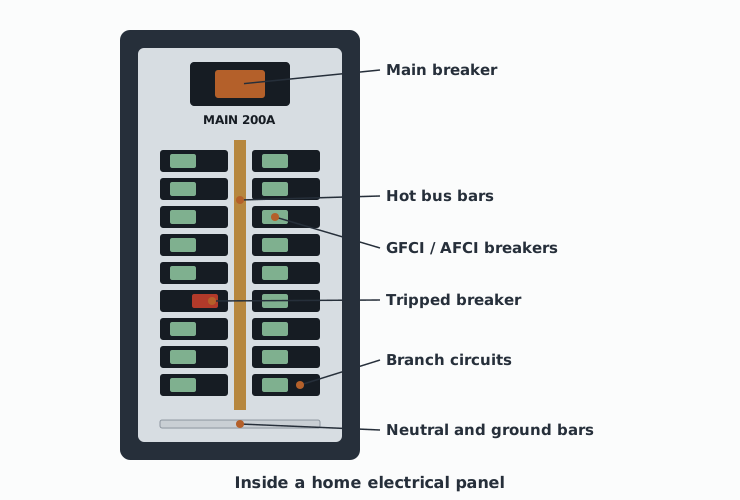
A tripping breaker is a safety device doing its job. The question is why. In Spokane, the most common culprits are space heaters in winter, kitchens with too few circuits for modern appliances, bathroom circuits shared by two hair dryers, and old outlets with worn or loose connections. Our main Spokane electrical repair guide covers other warning signs.
Why Breakers Trip
| Type of trip | What it means | What to do |
|---|---|---|
| Trips after a while with several things running | Overload: more current than the circuit can carry | Move loads to other circuits; add a dedicated circuit |
| Trips instantly when reset | Short circuit: hot wire touching neutral or ground | Leave it off; call an electrician |
| GFCI trips near water | Ground fault: current leaking to ground | Unplug devices, reset; recurring trips need diagnosis |
| AFCI trips randomly | Arcing detected, or a device the AFCI doesn’t like | Electrician tests the circuit and devices |
| Old breaker trips at low loads | Worn breaker | Replace the breaker with the correct type |
Swapping a 15-amp breaker for a 20 to stop trips lets the wire overheat. Breakers are matched to wire size.
Outlet Problems and Upgrades
- Loose outlets where plugs fall out: worn contacts, replace the outlet.
- Scorched or discolored outlets: overheating connection, turn off and replace.
- Two-prong outlets: no ground. Options include running a ground, GFCI protection labeled “no equipment ground,” or rewiring.
- Backstabbed outlets that fail: re-terminate on screws or replace.
- Not enough outlets: add outlets or dedicated circuits instead of power strips.
- Outdoor and garage outlets: weather-resistant GFCI outlets with in-use covers.
- USB and smart outlets: convenient upgrades during other work.
GFCI and AFCI Protection
GFCI (ground-fault circuit interrupter) protection prevents shocks near water and is required by code in bathrooms, kitchens, laundry areas, garages, unfinished basements and outdoors. AFCI (arc-fault circuit interrupter) protection detects dangerous arcing in damaged cords and wiring and is required for many living-area circuits in new and remodeled work. Both can be outlets or breakers.
Test GFCIs monthly with the test button. If one won’t reset, or trips constantly, an electrician can find out whether it’s the device, moisture in an outdoor box, or a real fault. In older homes, adding GFCI protection is one of the cheapest safety upgrades you can make. For homes with lots of two-prong outlets, see rewiring.
Winter Trips in Spokane
Electricians here see a jump in breaker calls every winter. Space heaters draw up to 1,500 watts, nearly a full 15-amp circuit by themselves. Add a TV and lamp on the same circuit and it trips. Heat tape, block heaters and holiday lights do the same outdoors. Plug space heaters directly into a wall outlet, never into power strips or extension cords, and if a room needs constant supplemental heat, consider a dedicated circuit or a panel upgrade for a heat pump.
Kitchens and Bathrooms: Where Trips Happen Most
Kitchens in older Spokane homes often have one or two circuits for the whole room. Run a microwave, toaster and coffee maker at once and the breaker trips. Modern code calls for at least two 20-amp small-appliance circuits on kitchen counters, plus dedicated circuits for things like the dishwasher, disposal and microwave. Bathrooms need a 20-amp circuit, and hair dryers alone can draw most of it. When remodeling, adding circuits is usually easy; even without a remodel, an electrician can often run a new circuit to a problem area.
GFCI protection is required in both rooms. Where an old house has ungrounded outlets, GFCI protection is a code-recognized way to add shock protection without new wiring, as long as the outlets are labeled. For more on old wiring, see rewiring and knob and tube.
Adding Outlets and Circuits
Most homes don’t have outlets where people need them today: behind the TV, at a desk, in the garage, on the patio. Adding outlets on an existing circuit works if the circuit has capacity. For heavy loads like a freezer, workshop tools, a microwave or a space heater, a dedicated circuit is better. The electrician checks the panel for space and capacity, runs the wire, and installs the right protection. If your panel is full, a panel upgrade may come first.
| Need | Usual solution |
|---|---|
| Outlet behind TV or desk | Add outlet on existing circuit |
| Garage freezer or tools | Dedicated 20-amp circuit |
| Space heater in a cold room | Dedicated circuit, or a permanent heater |
| Patio or yard power | Weather-resistant GFCI outlet with in-use cover |
| Hot tub | Dedicated 240-volt GFCI circuit |
Aluminum Wiring
Some Spokane homes built in the late 1960s and 1970s, especially in north Spokane and Spokane Valley, have aluminum branch wiring. It isn’t a problem by itself, but connections at outlets and switches can loosen and overheat over time, especially with devices not rated for aluminum. Signs include warm outlets, flickering lights and outlets that stop working. An electrician can repair connections with approved connectors or recommend other remedies. Don’t try to fix aluminum connections with standard wire nuts.
Replacing Breakers the Right Way
Breakers do wear out. Older breakers may trip at lower currents than they should, or fail to trip when they should. A replacement must be the right brand and type for the panel, the right amperage for the wire, and the right protection for the location, which may mean an AFCI or GFCI breaker instead of a standard one. An electrician also checks the bus bar where the breaker connects; a burned or pitted bus can mean the panel itself needs replacing. If several breakers are failing or the panel is an older brand, a panel upgrade may be the better fix.
Outlet Safety for Families
Tamper-resistant outlets, GFCI protection in wet areas and covers on unused outdoor outlets are simple safety upgrades. Avoid cheater plugs that let three-prong cords plug into two-prong outlets, and keep cords out from under rugs and furniture where they can be crushed. If outlets feel loose or plugs fall out, replace them before they overheat.
FAQ
Outlet and Breaker Questions
Why does my breaker keep tripping?
Most often an overloaded circuit, a short or a ground fault. If it trips when you add a load, it’s probably overload; if it trips immediately, there’s likely a fault. Have an electrician check it.
Can I replace an outlet myself?
Washington allows some homeowner work on your own home with a permit. If you’re not trained, it’s safer and often required to use a licensed electrician.
Why won’t my GFCI reset?
It may have a fault downstream, moisture in an outdoor outlet, or the device may have failed. If it won’t reset with everything unplugged, call an electrician.
Are two-prong outlets safe?
They work, but they’re ungrounded. Grounded or GFCI-protected outlets are safer, especially for electronics and in kitchens and bathrooms.
How many space heaters can go on one circuit?
Usually one. A typical heater uses most of a 15-amp circuit, so don’t share it with other big loads.
What is a dedicated circuit?
A circuit serving one appliance, like a microwave, freezer, space heater or EV charger, so it doesn’t overload shared outlets.
Should my outlets be tamper-resistant?
Modern code requires tamper-resistant outlets in most homes. They have internal shutters that help keep children from inserting objects.
What is a USB outlet?
An outlet with built-in USB charging ports. It installs like a regular outlet but needs a deeper box sometimes.
How much does it cost to add an outlet?
It depends on distance to a power source, wall type and whether a new circuit is needed. An electrician can quote after seeing the space.
Why does my outdoor outlet trip when it rains?
Moisture is getting into the outlet or a plugged-in cord, causing a ground fault. A weather-resistant outlet with an in-use cover usually fixes it.
Can a bad outlet cause a breaker to trip?
Yes. A damaged outlet or loose connection can cause a short or arcing that trips the breaker.
Breaker or outlet problem? Talk to an electrician.
One free call connects you with an independent licensed electrician in Spokane.
How the referral works