
Spokane County, Washington
Electrician in Spokane, WA
One free call connects you with an independent, licensed electrical contractor that works in your part of Spokane. A local electrician finds the fault, explains the fix and gives you a price before any work starts.
Spokane Electric Pros is a referral service, not an electrical contractor. How it works.
An electrician in Spokane, WA spends most days on three kinds of work: repairs, such as dead outlets, tripping breakers and flickering lights; upgrades, like replacing old fuse boxes and 100-amp panels, rewiring early-1900s homes on the South Hill and in the older neighborhoods, and adding circuits; and new loads, mainly EV chargers, heat pumps and standby generators. All of it must be done by a contractor licensed with Washington’s Department of Labor & Industries, usually under an electrical permit.
Why Spokane Homes Keep Electricians Busy
Spokane has one of the older housing stocks in the Northwest. Neighborhoods like Browne’s Addition, the South Hill around Manito Park, the Perry District, Garland and West Central are full of homes built from the 1890s to the 1940s, when electricity was new and a house might have had a handful of outlets. Many still have pieces of the original knob-and-tube wiring hidden in the walls and attic, ungrounded two-prong outlets, or a fuse box that was replaced with a small panel decades ago. Those homes now power refrigerators, microwaves, space heaters and computers the original wiring was never meant to carry.
Then there’s the weather. Inland Northwest winters are long and cold, so furnaces, heat pumps, block heaters and space heaters all pull hard on circuits from November to March. Windstorms knock down trees and power lines, and the November 2015 windstorm left about 180,000 Avista customers without power, some for more than a week. Summer heat waves and wildfire-season outages have made generators and backup power far more common. Call an electrician if a breaker keeps tripping, outlets or switches feel warm, lights flicker or dim, you smell something burning, you have a fuse box or aluminum branch wiring, or you’re adding a big load like an EV charger or hot tub.

Why one call works
Get It Fixed Right the First Time
Electrical work is not the place for guesswork or a cousin with a YouTube video. Every call goes to a licensed contractor who knows Spokane’s permit rules and older homes.
Call (509) 800-4990L&I-Licensed Only
Washington-licensed electrical contractors with certified electricians on the job, never a handyman.
Price Before Work
The electrician finds the cause first, then gives you a clear price. Nothing starts until you say yes.
Permits Handled
City of Spokane or L&I, the contractor pulls the right permit and books the inspection.
Local and Quick
Contractors who already work in your part of the county, from the South Hill to Liberty Lake.
Electrical services in Spokane
What Spokane Electricians Fix Every Week
Each service has its own guide with what to check before the electrician arrives.
Electrical Repair
Dead outlets, flickering lights, buzzing switches and circuits that quit after a storm.
Panel Upgrades
Fuse boxes and 60 or 100-amp panels replaced with modern 200-amp service, coordinated with Avista.
Outlets & Breakers
Breakers that trip, GFCIs that won’t reset, and new outlets where you actually need them.
Rewiring & Knob and Tube
Original wiring in Spokane’s older homes, replaced room by room or all at once.
EV Charger Installation
Level 2 chargers on a dedicated 240-volt circuit, sized to your panel, with a permit.
Generators & Backup Power
Standby generators and safe portable hookups, so the next windstorm doesn’t leave you cold.
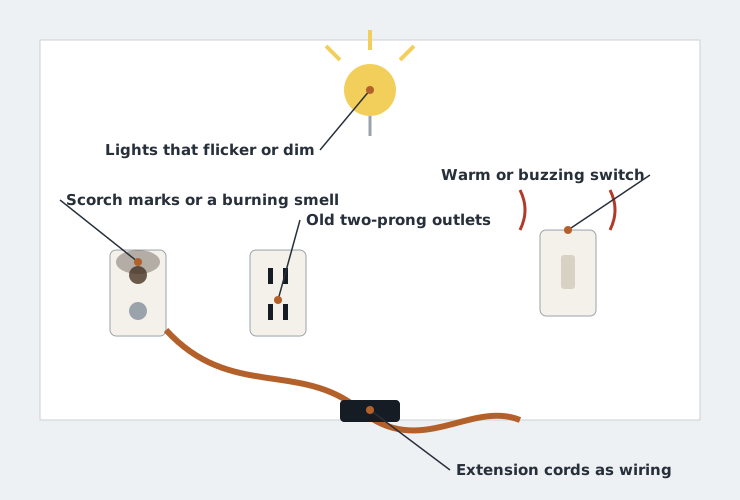
Problem checker
What Is Your Electrical System Telling You?
Most electrical problems give warning signs first. Match what you see to the likely cause.
Tap everything you’ve noticed and the checker points you to the guide that fits best. It’s a starting point, not a diagnosis. If you smell burning, see sparks or an outlet is hot, turn off that breaker and call an electrician now; if there’s smoke or fire, call 911.
Electrical problems at a glance
| What you notice | What it usually means | Where to start |
|---|---|---|
| Breaker trips when two appliances run | An overloaded circuit, often a kitchen or bathroom | Outlet and breaker repair |
| Breaker trips instantly when reset | A short circuit or ground fault somewhere on that circuit | Electrical repair |
| Lights dim when the furnace or AC starts | Heavy loads on a small service, or a loose connection | Panel upgrade |
| Warm outlet or switch plate | A loose or failing connection heating up | Electrical repair (turn it off first) |
| Two-prong outlets throughout the house | Ungrounded wiring, sometimes knob and tube | Rewiring |
| Fuses instead of breakers | An original or early service that’s likely undersized | Panel upgrade |
The in-depth guide
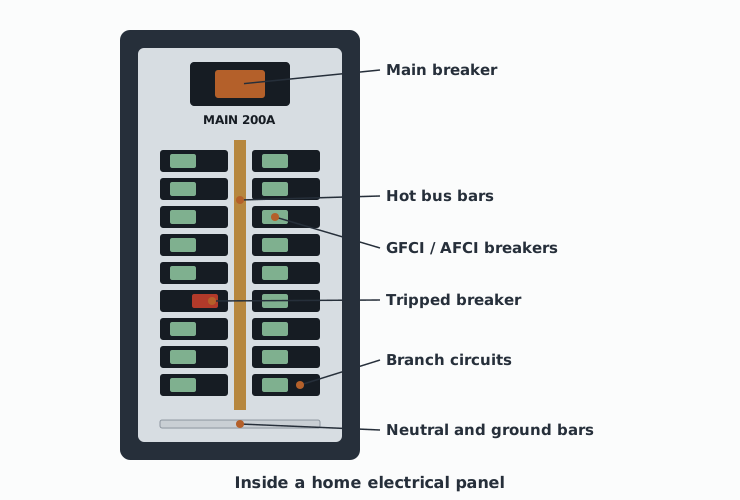
Inside Your Electrical Panel
A few minutes with the basics makes any electrician’s recommendation easier to follow.
How a home electrical system works
Power comes from Avista’s lines to the meter on the outside of your house, then into the service panel. At the top is the main breaker, which can shut off everything at once. Below it, two bus bars feed rows of branch circuit breakers, each protecting the wires that run to a group of outlets, lights or a single appliance. A breaker trips, snapping to the middle position, when it senses too much current, so the wire doesn’t overheat.
Newer panels include GFCI protection, which trips on ground faults around water such as bathrooms, kitchens, garages and outdoors, and AFCI protection, which detects the kind of arcing that starts fires in damaged wiring. Washington follows the National Electrical Code with state amendments, and both are required in many places in new and remodeled work.
Why panels and services get outgrown
Many older Spokane homes were wired for 60 or 100 amps. That was plenty for lights, a range and a refrigerator. Add an electric furnace or heat pump, a hot tub, a second refrigerator in the garage, a dryer and an EV charger, and the panel runs out of space and capacity. Symptoms include frequent trips, lights dimming when big appliances start, and an electrician telling you there’s no room for a new circuit. See the panel upgrade guide for how the upgrade works with Avista.
Inland Northwest weather
What Spokane Weather Does to Your Electrical System
Wind, ice, cold and heat all show up in local electricians’ work orders.
Windstorms and ice
Spokane’s biggest outages have come from wind and ice. Ice Storm ’96 coated the city in ice and brought down lines and trees for days in November 1996. On November 17, 2015, a windstorm toppled thousands of trees and left about 180,000 Avista customers, nearly half its customers, without power, with full restoration taking about ten days. Storms like these damage service masts, meter bases and the wires that connect your house to the grid; Avista fixes its lines, but the mast and meter base on your house are the owner’s responsibility and need a licensed electrician.
Cold winters, heavy loads
From November through March, heating loads put the most strain on old wiring. Space heaters on extension cords, block heaters, heat tape on pipes and electric furnaces all draw a lot of current for hours at a time. That’s when weak connections show up as warm outlets and tripping breakers.
Heat waves and wildfire season
The June 2021 heat dome pushed Spokane past 100°F for days, and smoke and fire danger have led to more outages in summer. Heat pumps and window AC units now run hard in July and August too. Many homeowners respond by adding a standby generator or a safe connection for a portable one.

Safety first
Electrical Emergencies: What to Do, and What Not to Do
Most electrical fires start with warning signs people ignored. Here’s how to respond.
Do this right away
- Smell burning or see smoke? Shut off the main breaker if you can do it safely, get everyone out and call 911.
- Warm, buzzing or scorched outlet or switch? Turn off that circuit’s breaker and leave it off until an electrician checks it.
- Downed power line? Stay at least 35 feet away and call Avista or 911. Assume every line is live.
- Breaker that trips the moment you reset it? Leave it off. There’s a fault on that circuit.
- Water near outlets or the panel after a burst pipe? Stay out of the water and call an electrician before touching anything.
Don’t do this
- Don’t keep resetting a breaker that keeps tripping. It’s protecting you from overheated wire.
- Don’t replace a breaker with a bigger one to stop the trips. The wire is sized for the breaker.
- Don’t backfeed a generator into a dryer outlet. It can electrocute line workers and burn the house.
- Don’t run space heaters on extension cords or power strips.
In Washington, electrical work for others must be done by an L&I-licensed electrical contractor using certified electricians, and most work needs a permit and inspection. Unlicensed work can void insurance and fail a home inspection when you sell.
Before you hire
Washington Electrical Rules Worth Knowing
A quick license check and a permit protect your home, your insurance and your resale value.
Washington licensing and permits
Washington is strict about electrical work. Electrical contractors must be licensed by the Department of Labor & Industries (L&I), and the people doing the work must hold an electrician certificate or be properly supervised trainees. You can look up any contractor’s license, bond and insurance on L&I’s website in a minute.
Most electrical work needs a permit and inspection. In Washington, permits come from L&I, except in cities that run their own electrical inspection programs, and the City of Spokane is one of them. In Spokane Valley, Liberty Lake, Mead, Cheney and unincorporated Spokane County, work is usually permitted through L&I. A licensed contractor knows which applies and pulls the permit.
Questions to ask any electrician
- What is your L&I electrical contractor license number?
- Will you pull the permit, and who schedules the inspection?
- Is the person doing the work a certified electrician?
- What exactly is wrong, and what are my options?
- Is the price fixed or hourly, and what’s included?
- What warranty covers your work and the parts?
Washington allows homeowners to do electrical work on their own home in some cases, with a permit and inspection. Rules are specific; check with L&I or the City of Spokane before you start.
How it works
From First Call to Power Back On in Four Steps
The first step is simple, so a licensed local electrician can get to the problem quickly.
You call and describe it
Tell us what’s happening and where you are. The call to (509) 800-4990 is free.
You’re connected locally
Your call goes to an independent, licensed electrical contractor that serves your part of Spokane County, when one is available.
The electrician diagnoses
They find the cause, explain your options and give you a price before any work begins.
You approve, they fix it
Nothing happens until you say yes. The contractor does the work, pulls any permit and stands behind it.
Cost & estimates
What Drives the Price of Electrical Work
Every job is different, but the same factors raise or lower every estimate.
Electricians price work in a few ways: a service-call or diagnostic fee to find the problem, flat rates for common jobs like replacing an outlet or installing a fixture, and project quotes for bigger work like panel upgrades, rewiring and EV chargers. Be wary of firm prices over the phone for anything beyond the simplest job; until someone sees the panel and wiring, it’s a guess.
Bigger jobs depend on what’s behind the walls. A panel upgrade that also needs a new service mast, meter base or grounding costs more. Rewiring a plaster-walled 1910 house on the South Hill takes longer than a 1990s house in Spokane Valley with open attic access. Permits and inspections add a fee but protect you.
If you need an electrician for one problem, list everything else you’ve been meaning to fix. Adding a few outlets or a fixture to an existing visit usually costs less than a separate trip.
What moves the price of electrical work
| Factor | Why it matters |
|---|---|
| Diagnosis time | Intermittent problems take longer to trace. |
| Access | Finished basements, plaster walls and tight attics slow the work. |
| Age of the home | Older wiring may need updating to meet code once it’s opened. |
| Panel capacity | Adding circuits may require a bigger panel or service. |
| Materials | Breaker types, wire size and fixtures vary widely in cost. |
| Permit and inspection | Required for most work; a fee but worth it. |
| Urgency | Nights, weekends and emergencies often cost more. |
Know your house
Spokane Homes and the Wiring Inside Them
The age of your home says a lot about what an electrician will find.


| Home type | Where you find it | Electrical issues to expect |
|---|---|---|
| 1890s–1920s Victorians and Craftsman homes | Browne’s Addition, South Hill, Cliff/Cannon, West Central | Knob and tube, cloth-wrapped wire, few outlets, fuse boxes |
| 1920s–1940s bungalows and cottages | Garland, Perry District, Logan, Emerson-Garfield | Ungrounded outlets, small panels, attic splices |
| 1950s–1960s ranches | Northwest Spokane, Shadle, Lincoln Heights, Spokane Valley | 100-amp panels, two-prong outlets, overloaded kitchens |
| 1970s homes | North Spokane, Spokane Valley, Indian Trail | Some aluminum branch wiring, aging panels |
| 1990s–2020s subdivisions | Liberty Lake, Mead, Five Mile, Moran Prairie | EV chargers, hot tubs, generators, smart home add-ons |
| Rural and acreage homes | Green Bluff, Nine Mile Falls, Cheney area | Long service runs, outbuildings, wells and pumps |
Spokane is a city of neighborhoods. There’s downtown and Riverfront Park around the Spokane Falls; Gonzaga University and the Logan neighborhood; the mansions of Browne’s Addition; the South Hill climbing up from Manito Park; the Garland District’s old theater; and suburbs stretching out to Spokane Valley, Liberty Lake, Mead and Cheney, home of Eastern Washington University. Out west, Airway Heights sits by Fairchild Air Force Base. Each area grew in a different era, and a Spokane electrician can often guess what’s inside your walls from the street.
Service area
Electricians Serving Spokane and the Surrounding Area
From the South Hill to Liberty Lake, the most common jobs change with the age of the homes.
1950s ranches to new builds along Sprague and Sullivan, with lots of panel and EV work. See electricians in Spokane Valley.
Newer neighborhoods, hot tubs, EV chargers and generators. Read about Liberty Lake electrical work.
Growing subdivisions and acreage near Green Bluff and Mt. Spokane. See electricians in Mead.
College rentals, older homes and rural properties west of the city. Visit Cheney electricians.
Deer Park, Medical Lake, Millwood, Nine Mile Falls, Otis Orchards and Greenacres can call too. Contact details.
Transparency
How Our Referral Service Works
Clear about who we are, and what to check before anyone opens your panel.
Spokane Electric Pros is a referral service, not an electrical contractor. When you call, we connect you with an independent, licensed electrical contractor that serves your area. That company diagnoses the problem, gives you a price, does the work and stands behind it. The call is free and you’re never obligated to hire anyone. We may be paid by participating companies for referrals.
Because the contractor is a separate business, check them the way you’d check anyone working on your home: an L&I license, a permit for the work, a clear price and a warranty. Our about page explains how the referral works.
Signs you’ve found a good electrician
- They give you their L&I license number without hesitation
- They explain the cause, not just the fix
- They pull permits and schedule inspections
- They leave the panel labeled and the work area clean
- They put the price and warranty in writing
Before and after
Keep Your Electrical System Safe, and What to Have Ready
A few habits catch most electrical problems early.
Simple habits that prevent electrical problems
- Test GFCI outlets monthly with the test and reset buttons, and smoke detectors too.
- Label your panel so you can shut off the right circuit fast.
- Don’t daisy-chain power strips or run cords under rugs.
- Keep space heaters plugged directly into the wall, away from curtains and bedding.
- Replace warm or loose outlets before they fail.
- Get an inspection when you buy an older home or before a remodel.
What to have ready when you call
- Your address or nearest cross streets
- What happened, and when
- Which rooms or circuits are affected
- Roughly when the house was built
- Panel type or a photo of it
- Whether anything smells hot or burnt
A photo of your panel with the door open helps the electrician come prepared with the right parts.
FAQ
Electrical Questions from Spokane Homeowners
How do I find a good electrician in Spokane, WA?
Check the contractor’s license on L&I’s website, ask whether they’ll pull a permit, and get the price and warranty in writing. Calling us connects you with an independent licensed electrician; you can still ask all these questions before you hire.
Who is the best electrician in Spokane?
The best electrician for you is licensed, explains the problem clearly, pulls permits and stands behind the work. We don’t rank companies; we connect you with an independent local electrician, and you’re free to compare.
Why does my breaker keep tripping?
Usually an overloaded circuit, a short circuit or a ground fault. If it trips when you run several appliances, the circuit is overloaded. If it trips instantly on reset, there’s likely a fault. Either way, don’t keep resetting it; have it checked.
Is knob and tube wiring dangerous?
It isn’t automatically dangerous, but it’s old, ungrounded and often damaged or buried in insulation, which it wasn’t designed for. Many insurers ask about it. An electrician can assess it and recommend repairs or replacement.
Do I need a permit for electrical work in Spokane?
Most electrical work needs a permit and inspection. In the City of Spokane, the city runs its own electrical permit program; elsewhere in Spokane County, permits usually come from L&I. Your contractor should pull it.
How do I know if I need a panel upgrade?
Common signs: a fuse box, a 60- or 100-amp service, no space for new breakers, frequent trips, lights dimming when big appliances start, or plans to add an EV charger, heat pump or hot tub.
Can I install an EV charger in my Spokane home?
Most homes can, but a Level 2 charger needs a dedicated 240-volt circuit and enough panel capacity. An electrician does a load calculation first, then installs it with a permit.
What should I do if my power goes out?
Check whether neighbors are out and Avista’s outage map. If only your house or part of it is out, check the panel. If a breaker won’t reset or the meter or mast is damaged, call an electrician.
Is a whole-house generator worth it in Spokane?
For homes that have lost power for days in windstorms or ice storms, or that depend on a well pump or medical equipment, many owners find it worth it. A portable generator with a proper transfer switch or interlock is a lower-cost option.
Does it cost anything to call Spokane Electric Pros?
No. The referral call is free and there’s no obligation. Any diagnosis, estimate and work are offered and priced by the independent electrical contractor you’re connected with.
Electrical problem? Talk to a local electrician.
One free call connects you with an independent, licensed electrical contractor that serves Spokane and Spokane County.
How the referral works