Outlets, switches, lights & circuits
Electrical Repair in Spokane, WA
Half the kitchen outlets quit, the hallway light flickers, a switch feels warm. Here’s what usually causes common electrical problems in Spokane homes, what you can safely check, and when to call a licensed electrician.
Free referral to an independent, L&I-licensed electrical contractor. You’re never obligated to hire.

What Electrical Repair Covers
Electrical repair in Spokane, WA means finding and fixing faults in your home’s wiring and devices: dead or loose outlets, switches that buzz or feel warm, lights that flicker, circuits that stopped working, tripped GFCIs that won’t reset, damaged service masts or meter bases after storms, and connections that have overheated. A licensed electrician traces the problem to its source rather than just replacing the part that failed.
Most electrical problems come down to a handful of causes: a loose connection at an outlet, switch or splice; an overloaded circuit; a failing device; or damage from water, rodents or a nail through a wire. In older Spokane homes, add brittle cloth insulation, old splices in the attic and outlets that have worn out after decades of plugging and unplugging. Repairs are the most common reason people call an electrician in Spokane, WA.
Warning Signs You Shouldn’t Ignore
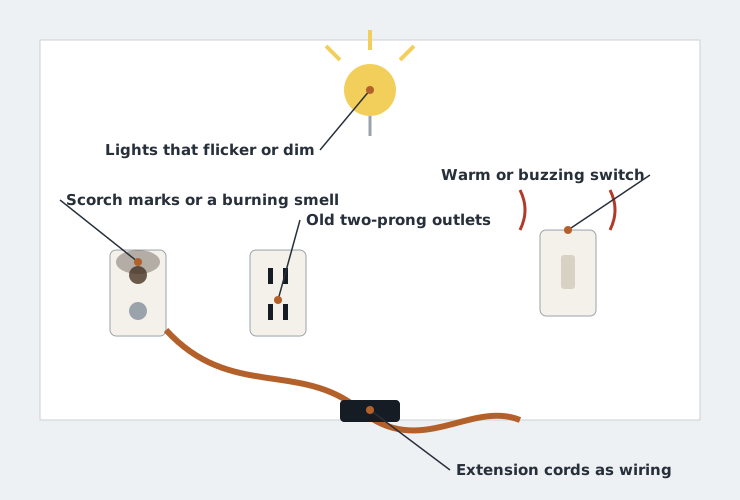
- Burning smell or a faint fishy odor near an outlet, switch or the panel. Turn off the circuit.
- Warm or hot outlets and switch plates, or scorch marks around them.
- Buzzing, crackling or sizzling from an outlet, switch, fixture or the panel.
- Lights that flicker or dim, especially when appliances start.
- Outlets that spark more than a tiny flash when something is plugged in.
- Loose outlets where plugs fall out.
- A circuit that died with no tripped breaker.
- Mild shocks from an appliance, faucet or switch.
Smoke, flames, sparking that doesn’t stop, or a hot panel: shut off the main if it’s safe, get out and call 911.
What You Can Safely Check First
A few checks are safe for most homeowners:
- Look at the panel. A tripped breaker sits in the middle position. Push it fully off, then on. If it trips again right away, stop.
- Check GFCI outlets. One GFCI in a bathroom, kitchen, garage or outside often protects other outlets downstream. Press reset.
- Try a different bulb before assuming a fixture is bad.
- Unplug everything on a dead circuit, then reset, to see if one device is the problem.
Leave anything involving opening outlets, switches, fixtures or the panel to a licensed electrician. Washington requires licensed contractors for work done for others, and most repairs beyond swapping a bulb need a permit.
Common Causes Electricians Find
| Problem | Common cause | Typical fix |
|---|---|---|
| Dead outlets on part of a circuit | Loose backstab connection or tripped GFCI upstream | Re-terminate or replace outlet; reset or replace GFCI |
| Flickering lights in one room | Loose fixture or switch connection | Tighten or replace the connection or switch |
| Flickering throughout the house | Loose neutral at the panel or service | Electrician and Avista check the service right away |
| Warm switch or dimmer | Overloaded dimmer or failing switch | Replace with a correctly rated device |
| Circuit dead, no trip | Burned splice or broken wire | Trace and repair; may need a new run |
| Shocks from a fixture | Missing ground or reversed wiring | Correct the wiring and grounding |
Repairs After Windstorms and Outages
When a tree or limb takes down the line to your house, Avista repairs its service drop, but the weatherhead, service mast and meter base on your house belong to you. If they’re bent or torn away, Avista usually can’t reconnect until a licensed electrician repairs them and the work passes inspection. After the November 2015 windstorm, many Spokane homes waited on exactly this repair.
Power surges when service returns can also damage electronics and appliances. Whole-home surge protection installed at the panel is a common add-on after a storm. If outages are a regular problem, see our generator installation guide, and if trips keep happening on the same circuit, read about outlet and breaker repair.
Repairs in Older Spokane Homes
In houses built before the 1950s, a simple repair can turn up bigger questions. An electrician replacing a dead outlet on the South Hill may find cloth-insulated wire that crumbles when it’s moved, a box with no ground, or a splice hidden in the wall with no junction box. Good electricians fix the problem you called about, then tell you plainly what else they saw and how urgent it is. Some issues, like brittle insulation at a fixture, are worth fixing on the spot; others, like ungrounded outlets throughout the house, can be planned for later.
Older homes also have quirks that make repairs take longer: plaster and lath walls, balloon framing with open cavities, old fixtures mounted to gas pipes from the days of combination gas and electric lighting, and decades of additions by different owners. Ask whether the price is flat or hourly, and whether it covers small surprises. If the wiring is in poor shape overall, our rewiring guide explains your options.
Surges, Flickers and Sensitive Electronics
Home offices, smart thermostats, furnaces with electronic controls and heat pumps are all sensitive to voltage problems. Surges come from lightning, utility switching and power returning after outages, and from inside the house when big motors start. A whole-home surge protector installed at the panel, combined with plug-in protectors for computers and TVs, gives layered protection. If lights flicker throughout the house rather than in one room, don’t ignore it: a loose neutral can send damaging voltage to outlets, and it needs an electrician and often Avista to check the service.
How Electrical Repairs Are Priced
Most repair visits start with a trip charge or diagnostic fee, then either a flat rate for the repair or time and materials. Simple jobs, like replacing an outlet, switch or GFCI, are often flat rate. Tracing an intermittent fault in an old house can take longer. Emergency calls at night or on weekends usually cost more. Ask for the price before work starts, and if you have several small problems, list them all so they can be handled in one visit. Our outlet and breaker guide covers the most common small jobs.
Preventing Repeat Repairs
Many electrical repairs come back because the cause wasn’t fixed. Replacing a burned outlet without fixing the overloaded circuit behind it, or resetting a GFCI that trips because an outdoor box is full of water, only buys time. Ask the electrician what caused the failure and what would keep it from happening again. Sometimes it’s a new circuit, sometimes a weatherproof cover, sometimes moving a space heater to a different outlet.
FAQ
Electrical Repair Questions
Why did half my outlets stop working?
Often a tripped GFCI outlet upstream, a tripped breaker, or a loose connection at the first outlet in the chain. Check GFCIs and the panel first; if that doesn’t fix it, an electrician can trace the circuit.
Is a flickering light dangerous?
One flickering bulb is often just a loose bulb or bad fixture. Flickering throughout the house, or lights that brighten and dim, can mean a loose neutral connection, which is serious. Call an electrician, and Avista if it’s at the meter.
Should an outlet feel warm?
No. A warm outlet or switch plate usually means a loose or overloaded connection. Turn off the circuit and have it checked.
How fast can an electrician come out in Spokane?
It depends on the day and how busy contractors are; after storms, demand spikes. Tell us if it’s an emergency so we can try to connect you with someone available.
Who fixes my meter base after a storm?
Avista handles its lines and meter; the meter base, service mast and weatherhead on your house are repaired by a licensed electrician, then inspected before Avista reconnects.
Do small electrical repairs need a permit in Washington?
Many do. Some minor like-for-like repairs may be exempt. Your electrician will know which jobs require a permit in your jurisdiction.
What does a burning smell from an outlet mean?
Usually an overheating connection or device. Turn off the circuit at the panel and leave it off until an electrician checks it. If there’s smoke, call 911.
Can I use an outlet that sparks a little?
A tiny spark when plugging in can be normal; repeated or large sparks, or sparks with heat or scorch marks, are not. Stop using it and have it replaced.
Why do my lights dim when the furnace starts?
Large motors draw extra current when they start. Brief dimming can be normal on small services; persistent or dramatic dimming can mean a loose connection or overloaded service.
Electrical problem? Talk to a licensed electrician.
One free call connects you with an independent electrical contractor that handles repairs in Spokane.
How the referral works